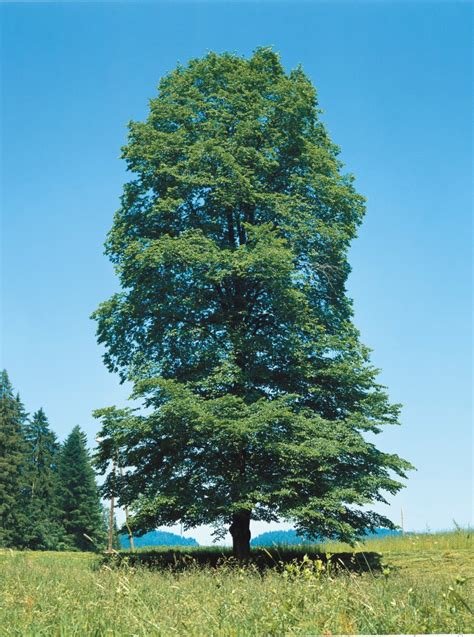
Linden: species, characteristics and use in mixed forests
Linden trees belong to the genusTiliaFamily Malvaceae. These are deciduous trees native to temperate regions of Europe, Asia, and North America. They are distinguished by heart-shaped leaves, fragrant flowers, and a characteristic long bract connected to the peduncle. Several dozen species and natural hybrids of lindens are recognized in the world flora.Plants of the World Online)
The linden tree's primary role in the forest is not only its honey supply. It creates soft humus, supports soil fauna, tolerates shade, forms a second layer, and helps long-standing oak forests maintain a humid microclimate.
Assessment in tables:
5- very high stability;
4— high;
3- average;
2- low;
1- very low.
Maximum comparative table of lindens
| View | Natural region | Height | Durability | Frost | Drought | Wet soils | Lime | City | Shadow | Height | Main feature | Best use |
|---|---|---|---|---|---|---|---|---|---|---|---|---|
| Small-leaved linden – Tilia cordata | Europe, Western Asia, Central Siberia | 20–30 m | 400–700 years, individual trees longer | 5 | 4 | 3 | 5 | 4 | 5 | Average | The most versatile European forest linden | Oak forests, second tier, shelterbelts, parks |
| Large-leaved linden - T. platyphyllos | Central and Southern Europe | 25–40 m | 400–800 years | 4 | 2–3 | 4 | 5 | 3 | 4 | Medium-fast | A large tree of fresh, rich slopes | Wet ravines, mountain forests, rich calcareous soils |
| European linden — T. × europaea | Natural hybrid of Europe | 25–40 m | 300–600 years | 4–5 | 3 | 3–4 | 5 | 4 | 4 | Fast | Hybrid of small- and large-leaved linden | Alleys, parks, estates, mixed forests |
| Silver linden - T. tomentosa | Southeastern Europe, Western Asia | 20–30 m | 200–400+ years | 3–4 | 5 | 2 | 4–5 | 5 | 3 | Average | Silvery underside of leaves, heat resistance | Cities, warm dry areas, southern slopes |
| Caucasian linden - T. dasystyla | Caucasus, Crimea, Northern Iran | 20–30 m | 300–600 years | 3–4 | 4 | 3 | 4 | 4 | 4 | Average | Heat-loving forest linden with good drought resistance | Caucasian and Southern European climate analogues |
| Crimean linden — T. × euchlora | A natural hybrid of Crimea and Northern Iran | 15–25 m | 200–400 years | 4 | 4 | 3 | 4 | 5 | 3 | Average | Clean crown, good urban stability | Streets, alleys, compact urban plantings |
| American linden — T. americana | Eastern and Central North America | 20–35 m | 200–400 years | 5 | 2–3 | 4 | 3 | 3 | 5 | Fast | Large leaves and a powerful shady crown | Cool, damp forests and large parks |
| Amur linden — T. amurensis | Far East, China, Korea | 20–30 m | 300–500 years | 5 | 3 | 3–4 | 3 | 3 | 4–5 | Average | Very frost-hardy Asian forest linden | Cold continental forests |
| Manchurian linden — T. mandshurica | Northeast Asia | 15–25 m | 200–400 years | 5 | 2–3 | 4 | 3 | 3 | 4 | Average | Large pubescent leaves, frost resistance | Cold, damp areas, arboretums |
| Japanese linden - T. japonica | Japan and Eastern China | 15–25 m | 200–400 years | 4–5 | 2–3 | 4 | 2–3 | 3 | 4 | Average | Close to small-leaved, loves a humid climate | Cool forest gardens and collections |
| Lipa Maximowicz - T. maximowicziana | Japan, Kuril Islands | 20–30 m | 200–400 years | 5 | 2 | 4 | 2–3 | 2–3 | 4 | Average | Very large leaves, cold resistant | Humid cool areas |
| Linden Henry - T. henryana | Central China | 10–20 m | 150–300 years | 2–3 | 3 | 3 | 2–3 | 3 | 3 | Slow | Young leaves with long ciliate teeth | Protected gardens with a mild climate |
| Chinese linden - T. chinensis | Central China | 15–25 m | 200–400 years | 4 | 2–3 | 3–4 | 3 | 3 | 4 | Average | Forest linden of East Asian origin | Arboretums and scientific plantings |
| Mongolian linden — T. mongolica | Mongolia, Northern China | 8–15 m | 150–300 years | 5 | 4 | 2 | 3–4 | 4 | 3 | Slow | Small, frost- and drought-resistant | Cold cities, forest-steppe, small areas |
Height and age ranges vary depending on climate, planting material, soil, and care. Old linden trees often develop hollow trunks, but the tree continues to thrive thanks to the active outer wood and crown regeneration.
1. Small-leaved linden is the main species for long-lasting forests
Cordate lime tree— the main choice for Central Europe. Its natural range extends from Europe to Central Siberia and Northern Iran. In Switzerland, it is found as a native forest species. The tree reaches approximately 30 m.Plants of the World Online)
| Indicator | Characteristic |
|---|---|
| Leaves | Small, usually 3–8 cm, glaucous below |
| Hairs | Reddish tufts at the corners of the veins |
| Bloom | Usually later than large-leaved linden |
| Flowers in an inflorescence | Usually 3-10 |
| Fruit | Small, relatively thin-walled |
| Crown | Dense, rounded |
| Root system | At first a distinct main root, later a powerful branched system |
| Shade tolerance | Very high |
| Overgrowth | Renews well from the stump and base of the trunk |
It grows on clays, loams, sandy and calcareous soils, tolerates acidic, neutral and alkaline reactions, but fresh, fertile and well-drained soils are optimal.rhs.org.uk)
Main advantages
suitable for the second tier of oak forest;
tolerates partial shade well;
relatively drought-resistant after rooting;
improves forest litter;
provides fragrant flowers for insects;
withstands periodic pruning and shoot management;
capable of living for centuries.
Restrictions
does not tolerate prolonged waterlogging well;
young plants are heavily eaten by deer and roe deer;
dense linden growth can shade oak undergrowth;
Sticky honeydew from aphids often appears under city trees.
2. Large-leaved linden - for rich, moist slopes
Tilia platyphyllos— a larger, more moisture-loving linden. It reaches about 40 m, has leaves up to 15 cm, and typically bears 2–5 flowers per inflorescence. In Switzerland, natural populations are primarily associated with warm valleys and the southern part of the country, although the species is widely planted.infoflora.ch)
| Parameter | Peculiarity |
|---|---|
| Soil | Deep, rich, often carbonate |
| Humidity | Higher than required for small-leaved linden |
| The best relief | Ravines, northern and eastern slopes, foothills |
| Drought | Tolerates worse than small-leaved |
| Frost | High resistance, but somewhat lower than T. cordata |
| Ecological role | A large tree of humid mixed forests |
Best companions:
sycamore;
ash tree;
rough elm;
beech;
English oak;
hazel;
elderberry;
viburnum.
For dry, open, southern slopes, large-leaved linden is usually inferior to field maple, small-leaved linden, or silver linden.
3. European linden is a powerful natural hybrid
Tilia × europaeawas formed by crossing small-leaved and large-leaved lindens. This hybrid is recognized as a natural European taxon. (Plants of the World Online)
Its features:
faster growth;
large crown;
good tolerance to urban conditions;
active formation of shoots around the trunk;
suitability for alleys;
intermediate moisture requirements.
The disadvantage is the abundant basal shoots and a very large crown. It's an inconvenient choice for a small plot.
4. Silver linden – for the heat and the city
Tilia tomentosaIt is native to Southeastern Europe and Western Asia. In Switzerland, it is mainly cultivated, and in the south, it occasionally grows wild.infoflora.ch)
The main distinguishing feature is the whitish-silvery, felt-like underside of the leaf.
Advantages
tolerates heat better than many linden trees;
relatively resistant to summer drought;
The reflective underside of the leaves reduces overheating;
grows well in the city;
forms an even decorative crown;
less attractive to some sucking insects than common urban linden trees.
Restrictions
less frost-resistant than small-leaved linden;
not intended for cold, swampy areas;
as an alien species it should not displace local linden trees in the natural forest;
A large tree requires a lot of space.
For warm cities and climatically dry areas, it is often more practical than large-leaved linden.
5. Crimean linden is a good outdoor hybrid
Tilia × euchlora— a hybrid of small-leaved linden and Caucasian linden. Its natural origin is associated with Crimea and northern Iran.Plants of the World Online)
Peculiarities:
more compact and neat crown;
shiny leaves;
less basal shoots than the European hybrid linden;
good resistance to urban conditions;
comparatively high heat and drought resistance;
suitability for streets and alleys.
For natural reforestation, native species are better, but for urban landscaping this is a useful hybrid.
How to distinguish the main European lime trees
| Sign | Small-leaved | Large-leaved | Silvery | European hybrid |
|---|---|---|---|---|
| Sheet size | Small | Large | Medium or large | Intermediate |
| Top of the sheet | Usually smooth | Often slightly pubescent | Dark green | Volatile |
| A series of leaves | Bluish | Green, hairy along the veins | White-felt | Intermediate |
| Hairs in the corners of the veins | Reddish | Whites | The entire underside is pubescent | Changeable |
| Tsvetkov | Usually 3-10 | Usually 2-5 | Usually 5-10 | Intermediate |
| Fetus | Easier to crush | Firm, with pronounced ribs | Solid | Volatile |
| Bloom | Later | Earlier | Later | Average |
| Drought resistance | High | Medium-low | Very high | Average |
| Shade tolerance | Very high | High | Average | High |
The ecological role of linden
1. Improving humus
Linden leaves contain relatively many bases—calcium, magnesium, and potassium—and usually decompose faster than coarse oak or beech litter.
In a mixed oak forest, linden helps:
reduce the accumulation of dense acidic litter;
support earthworms;
accelerate the processing of organic matter;
return minerals to the upper horizons;
form soft forest humus.
Therefore the combinationoak + lindenecologically stronger than pure oak planting.
2. Support pollinators
The fragrant flowers provide nectar and pollen to bees, bumblebees, hoverflies, and other insects. Different linden species bloom at slightly different times, so combining them can extend the period of food availability.
However, linden trees shouldn't be the only source of honey. During droughts, nectar production decreases, and a large number of insects can congregate on a limited resource.
3. Maintaining the microclimate
Dense crown:
shades the soil;
reduces evaporation;
protects oak trunks from sunburn;
reduces the temperature under the canopy;
retains air humidity;
creates a shadow second tier.
4. Regeneration of shoots
Linden regenerates well after damage or felling. This makes it valuable for:
forests damaged by storms;
slopes;
protective strips;
traditional coppice forestry;
long-term preservation of forest cover.
Soil and planting conditions
| Condition | The most suitable linden tree |
|---|---|
| Ordinary fresh forest soil | Small-leaved |
| Dryish calcareous soil | Small-leaved |
| Rich wet slope | Large-leaved |
| Hot urban area | Silvery |
| Street and alley | Crimean, silver, varietal small-leaved |
| Cold continental climate | Small-leaved, Amur |
| Cool, humid climate | Large-leaved, American, Japanese |
| Southern warm slope | Silver, Caucasian |
| Deep shadow of a young forest | Small-leaved |
| Heavy clay | Small-leaved, if there is no stagnant water |
| Limestone | Small-leaved, large-leaved |
| Acidic soil | Small-leaved tolerates, but develops better in richer soil |
| Floodplain with short-term moisture | Large-leaved or small-leaved on micro-elevation |
| Constant waterlogging | Linden is undesirable; alder and willow are better |
| Salty sea coast | Only in the protected second or third row |
Soil requirements
Optimal profile:
the depth of suitable soil is preferably at least 80–120 cm;
good aeration;
moderate moisture capacity;
no prolonged stagnation of water;
a neutral or slightly alkaline reaction is particularly favorable;
the presence of organic matter, but without adding fresh manure to the planting hole.
Small-leaved linden can grow on chalky, clayey, sandy and loamy soils with good drainage. (rhs.org.uk)
Compatible with oak, ash and maple
| Main tree | Compatibility with linden | Benefit | Possible conflict |
|---|---|---|---|
| English oak | 5/5 | Improves humus, protects the trunk, retains moisture | A linden tree can shade a young oak tree. |
| Sessile oak | 5/5 | Suitable for dry slopes | On very dry peaks, linden trees may not have enough water. |
| Downy oak | 3–4/5 | Useful in fresher soil pockets | Common linden is less drought-resistant. |
| Common ash | 5/5 | Forms a rich, multi-layered forest | Both species require fertile soil. |
| Field maple | 5/5 | Strong second tier, fast humus | May become too dense with undergrowth |
| Sycamore | 4/5 | Good on wet slopes | Together they are capable of strongly shading the lower tier. |
| Maple tree | 4/5 | A good urban and forest complex | Dense general shadow |
| Hornbeam | 5/5 | Stable second tier | Periodic windows are needed for oak undergrowth. |
| Elm | 5/5 | Rich ravine and slope forests | Requires monitoring of the condition of elms |
| Beech | 3/5 | Possible in damp mature forest | Beech can gradually displace linden and oak by light shading. |
The best companion trees for linden
| Satellite | Function |
|---|---|
| Oak | Durable upper frame |
| Ash tree | Light crown and fast mineral exchange |
| Hornbeam | Second tier and trunk protection |
| Field maple | Humus and filling of forest edges |
| Sycamore | Wet slopes and ravines |
| Elm | Deep rich soils |
| Merry | Flowers, fruits, temporary forest windows |
| Bereka | Dry limestone areas |
| Rowan | Fruits for birds and a cold-resistant second tier |
| Birch | Temporary pioneer canopy |
| Alder | Only in damp depressions |
Shrubs for linden undergrowth
| Bush | Conditions | Role |
|---|---|---|
| Hazelnut | Fresh fertile soil | Nuts, undergrowth, soft litter |
| Hawthorn | Light edge | Flowers, fruits, protection of young plants |
| Blood-red dogwood | Calcareous soils, partial shade | Fruits and slope strengthening |
| European spindle tree | Rich forest soil | Fruits, undergrowth structure |
| Viburnum | Wetter places | Fruits and dense, damp undergrowth |
| Black elderberry | Nitrogen-rich areas | Fast processing of nutrients |
| Privet | Warm, dry forest edges | Thick protective belt |
| Forest honeysuckle | Penumbra | Flowers, fruits, shelter |
| Rose hip | Light edges | Pollinators and fruits |
| Turn | Outer edge | Protection and early flowering |
| Buckthorn | Acidic damp areas | Food for insects and birds |
| Holly | Mild humid climate | Evergreen winter undergrowth |
Recommended layout around oak
Linden is especially useful as a "nurturant" tree next to oak.
| Element | Accommodation |
|---|---|
| The main oak | Group center |
| Linden trees | 2–4 trees 6–10 m from the oak |
| Field maples | In the middle and outer tiers |
| Hornbeam | From the north and east sides |
| Ash tree | In a light, damp sector |
| Hazelnut | 8-15 m from the center |
| Hawthorn and red | On the outer edge |
The linden tree should cover the side of the oak trunk, but not its crown. When the linden crown begins to compete with the oak's top, it is thinned out or formed into a second tier.
Landing distances
| Landing type | Estimated distance |
|---|---|
| Linden as a large free tree | 10–15 m |
| Linden in a mixed forest | 5–8 m at the start |
| Linden tree next to oak tree | Preferably 6-10 m |
| An alley of large linden trees | 8–12 m |
| A narrow alley of compact varieties | 5–8 m |
| Linden protective strip | 2.5–5 m with subsequent thinning |
| Coppice group | 2–4 m between parent plants |
The forest planting may be denser than the final structure. Subsequently, some trees are removed or transferred to the second tier.
Diseases and pests
Linden trees are generally considered relatively resilient, but are not completely problem-free.
| Problem | Manifestation | Risk conditions |
|---|---|---|
| Phytophthora root rot and bleeding ulcers | Root death, darkening and discharge on the bark | Waterlogging, compacted soil |
| Verticillium wilt | Wilting of individual branches or the crown | Contaminated soil, weakened trees |
| Aphid | Sticky honeydew on leaves and objects under a tree | City alleys, dry air |
| Gall mites | Red or green growths on leaves | Usually a decorative, non-dangerous problem |
| Leaf spots | Spots and early leaf fall | Wet weather |
| Mistletoe | Weakening of branches due to severe infestation | Old city trees |
| Deer damage | Eating young animals and shoots | Unprotected forest plantations |
Forest Research notes the risk of root infections and bleeding cankers associated with late blight, as well as the rare but potentially fatal verticillium wilt, for small-leaved linden. Young plants and shoots are particularly attractive to deer.Forest Research)
Priority for Switzerland and Central Europe
| Priority | View | Recommended role | Share among all trees |
|---|---|---|---|
| 1 | Small-leaved linden | The main second tier, oak forests, dry forest edges | 7–15% |
| 2 | Large-leaved linden | Fresh slopes, ravines, mountain forests | 3–8% |
| 3 | European hybrid linden | Parks, alleys, cultural landscape | 1–4% |
| 4 | Silver linden | Hot Cities and Future Climate Tests | 1–5% |
| 5 | Crimean linden | Streets and compact alleys | Limited |
| 6 | Asian and American species | Arboretums and scientific testing | Less than 1-2% of each |
For the natural forest of the Zurich Oberland region, it is reasonable to form the basis fromlocal small-leaved linden, and large-leaved linden should be planted on wetter and richer slopes. Silver linden is best used primarily in urban areas or in warm experimental sites.
The optimal role of linden in the forest DREVO
Linden should be considered assoil-climatic architect of the second tier:
oak creates a durable frame;
Ash provides light and rapid exchange of minerals;
maple fills the forest windows;
Linden stabilizes humus, humidity and shade microclimate;
hornbeam regulates the density of the lower canopy;
The bushes form a protective edge.
For a typical mixed broadleaf forest, a reasonable total proportion of linden trees is approximately10–20%, but not uniformly across the entire area. In dry oak areas, small-leaved linden dominates, in damp ravines, large-leaved linden, and in hot urban areas, silver linden.