DREVO River Rover Restore
Autonomous robotic platform for the restoration of riverbeds, banks and aquatic ecosystems
Concept
DREVO River Rover Restore (RRR)— a specialized autonomous robotic platform for the targeted restoration of rivers, streams, lakes, swamps, floodplains, lagoons, and coastal zones.
If River Rover Scoutexamines the reservoir,River Rover Cleanremoves artificial contaminants, andRiver Cargo PlatformAfter River Rover Restore removes the collected materials, it carries out the next step – returning the aquatic system to a stable natural structure.
The platform is not intended for large-scale riverbed reconstruction, but for local bioengineering work with minimal disruption to the ecosystem.
The main principle:
After cleaning, the reservoir must not be left empty, but its natural functions must be restored.
Main tasks
River Rover Restore performs:
restoration of the river bottom structure;
creation of stone thresholds and riffles;
formation of microcascades;
construction of channel widening;
restoration of spawning grounds;
strengthening of banks with natural materials;
planting of aquatic and coastal vegetation;
installation of biomats and coconut rollers;
creation of floating bioplateaus;
placement of wood elements;
restoration of shallow waters;
installation of environmental modules;
maintenance of restored areas.
Application areas
The platform is used:
on mountain streams;
small and medium rivers;
canals subject to environmental reconstruction;
lakes;
reservoirs;
floodplain reservoirs;
swamps;
deltas;
lagoons;
coastal shallow waters.
Basic design
The main platform is constructed using a stable catamaran design.
It includes:
two displacement pontoons;
central working deck;
one or two robotic manipulators;
Material storage module;
replaceable working tools;
navigation mast;
sonar and cameras;
positioning system;
stabilizing supports;
electric propulsion system.
The catamaran design provides:
stability during manipulator operation;
shallow draft;
ability to work in shallow water;
large usable deck area;
convenient placement of replaceable modules.
Main versions
River Rover Restore S
Compact version for streams and small rivers.
Main functions:
planting plants;
installation of small stones;
installation of biomats;
spot restoration of banks.
Estimated load capacity:
100–300 kg.
River Rover Restore M
Universal version.
Used for:
stone laying;
installation of wood elements;
formation of spawning grounds;
transportation of planting material;
installation of bioengineered structures.
Estimated load capacity:
500–1,500 kg.
River Rover Restore L
Heavy recovery platform.
Intended for:
laying large boulders;
installation of modular thresholds;
working with heavy wood;
coastal restoration;
installation of large bioplateaus.
Estimated load capacity:
2-5 t after engineering confirmation.
Robotic manipulators
The platform can be equipped with:
main power manipulator;
the second precision manipulator;
telescopic boom;
rotating platform;
roll compensation system.
Power manipulator
Used for:
movement of boulders;
installation of logs;
installation of thresholds;
loading and unloading of materials.
Precision manipulator
Used for:
planting of plants;
installation of sensors;
placement of biomats;
precise installation of small modules.
Replaceable working tools
Grab
For:
stones;
wood;
plant materials;
containers.
Small capacity bucket
For:
local removal of contaminated sludge;
formation of small depressions;
preparation of planting pockets.
Stone Capture
For precise placement of boulders.
Vibratory pile driver
To install:
wooden stakes;
anchors;
elements of biomats;
small piles.
Landing module
For:
coastal plants;
aquatic plants;
shrubs;
young trees on the banks.
Hydroseeding module
For application:
seed mixture;
mulch;
biodegradable binder;
microorganisms.
Biomat laying module
For installation:
coconut mats;
jute nets;
anti-erosion fabrics;
vegetable rolls.
River bed restoration
River Rover Restore does not level the bottom, but creates a varied structure.
Created:
rifts;
whirlpools;
gravel areas;
stone ridges;
areas of different depths;
fish shelters;
microzones with different flow rates.
This increases:
oxygen content;
habitat diversity;
channel stability;
the river's ability to self-purify.
Stone thresholds
The platform sets up small stone thresholds.
Their functions:
decrease in water speed;
longitudinal profile stabilization;
aeration;
preventing deepening of the riverbed;
creation of spawning areas.
Each threshold is designed with:
stable foundation;
central or distributed overflow;
protection against washing away;
passage for fish and other aquatic organisms.
Restoration of spawning grounds
The platform forms sections of:
washed gravel;
pebbles;
large stones;
tree shelters.
Before creating a spawning ground, the following should be taken into account:
species composition of fish;
flow speed;
depth;
temperature;
granulometric composition of the bottom;
breeding season.
Working with large timber
River Rover Restore installs:
trunks;
root systems;
tree debris;
coastal shelters.
Large timber:
creates shelters;
slows down the flow;
retains sediment;
forms pools;
increases the diversity of the channel.
Timber elements must be securely fastened and not pose a threat to bridges, people or infrastructure.
Restoration of the coast
Mainly natural materials are used:
stone;
wood;
live cuttings;
coconut rollers;
biomats;
local vegetation.
Possible methods:
living willow weaving;
fascines;
brushwood rollers;
laying of root systems;
planting shrubs;
formation of a gentle bank;
device of terraced edges.
Rigid concreting is used only where natural solutions are insufficient.
Planting plants
The platform disembarks:
Underwater plants
For:
bottom stabilization;
saturation of water with oxygen;
creation of a habitat.
Coastal and aquatic plants
For example:
sedges;
sieves;
irises;
rug;
local moisture-loving species.
Shrubs
For example:
willows;
дёрен;
viburnum;
local coastal shrubs.
Trees
In stable coastal areas:
alder;
elm;
ash tree;
willow;
local poplar species.
The selection of plants is always carried out according to local environmental conditions.
Floating bioplateaus
River Rover Restore can install floating islands with vegetation.
They perform the following functions:
biological water purification;
absorption of excess nutrients;
creation of shelters;
formation of nesting sites;
shading of water.
Platform:
delivers the module;
sets it;
fixes;
connects sensors;
controls the state.
Underwater biomodules
At the bottom there are modules made of:
porous ceramics;
natural stone;
mineral composites;
wood.
They create a surface for:
microorganisms;
algae;
periphyton;
shellfish;
invertebrates.
Work in swamps and floodplains
The amphibious version of the platform is used for:
restoration of shallow waters;
closing unnecessary drainage channels;
formation of water-retaining barriers;
planting of marsh vegetation;
restoration of oxbow lakes;
installation of sensors.
The platform must have low specific pressure and not destroy peat soils.
Working with River Cargo Platform
River Cargo Platform delivers:
stones;
gravel;
wood;
plants;
biomats;
replaceable tools;
battery.
After completion of the work, she takes away:
packaging;
contaminated material;
old structures;
excess sediment.
This way, River Rover Restore doesn't waste time on logistics.
Robot collaboration
Typical sequence:
River Rover Scoutsurveys the area.
WOOD AIforms a recovery plan.
River Rover Cleanremoves debris and hazardous objects.
River Cargo Platformdelivers materials.
River Rover Restorecarries out restoration work.
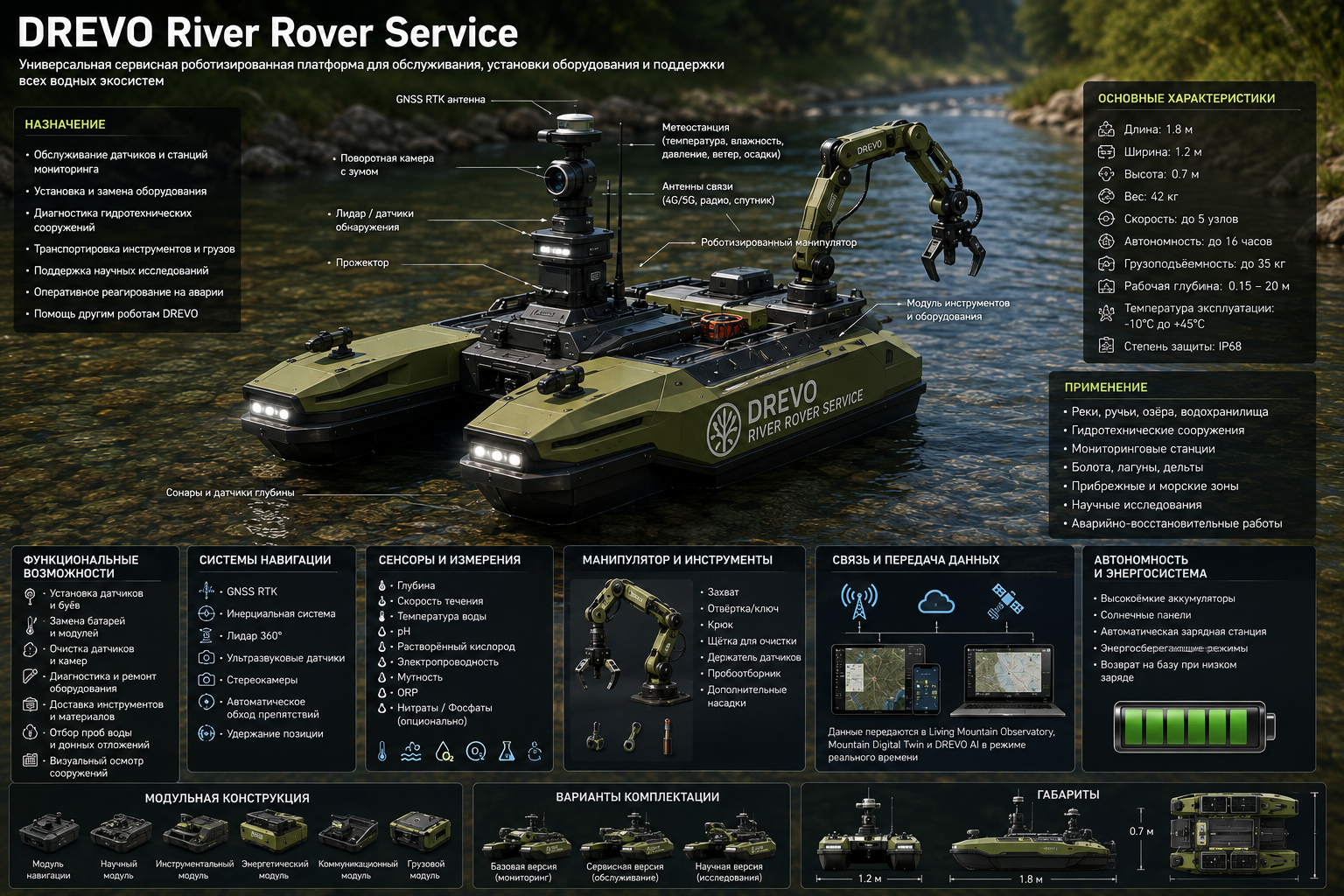
River Rover Serviceinstalls and maintains sensors.
Living Mountain Observatory monitors the outcome.
Mountain Digital Twin updates the digital model.
Navigation and positioning
The platform is equipped with:
GNSS RTK;
inertial system;
LiDAR;
sonar;
stereo cameras;
depth sensors;
current sensors;
automatic position holding system.
To accurately place stones or modules, the robot must maintain its position with an accuracy of a few centimeters under favorable conditions.
Stabilization during work
Used:
retractable bottom supports;
lateral stabilizers;
inflatable balloons;
automatic ballast system;
active roll compensation;
fixation to the shore or temporary anchors.
Before lifting a heavy object, the system checks:
depth;
flow;
mass of the object;
arrow flight;
bank;
reserve buoyancy.
Environmental safety
The platform automatically terminates when:
the appearance of people in the work area;
detection of large animals;
exceeding the permissible list;
strong current;
deterioration of visibility;
decreasing charge level;
damage to equipment.
Before the operation, DREVO AI checks:
spawning season;
nesting periods;
presence of rare species;
acceptable level of turbidity;
environmental restrictions of the site.
Turbidity control
When working with the bottom, the following are used:
turbidity sensors;
protective screens;
local sedimentation barriers;
tool speed limitation;
phased processing of the site.
If the turbidity exceeds the set limit, the operation stops automatically.
Power system
Recommended configuration:
LiFePO₄ batteries;
replaceable battery cartridges;
electric water jet propulsion;
separate battery for manipulators;
solar panels for auxiliary systems;
Automatic charging at DREVO River Hub.
Autonomy depends on the mode:
monitoring and landing - 8-16 hours;
operation of the power manipulator - 4-8 hours;
heavy operations - with regular battery replacement.
Digital integration
River Rover Restore is affiliated with:
Living Mountain Observatory;
Mountain Digital Twin;
WOOD AI;
TREVO AeroSense Drone;
DREVO River Rover Scout;
DREVO River Rover Clean;
DREVO River Rover Service;
DREVO River Cargo Platform;
WOOD Clean Rivers.
Each operation is recorded in the digital plot passport.
Digital Recovery Journal
For each site the following are saved:
coordinates;
before and after photos;
digital bottom model;
composition of the installed materials;
list of planted species;
volumes of work;
water quality data;
price;
date of service;
results of subsequent monitoring.
Preliminary specifications of the Restore M version
| Parameter | Meaning |
|---|---|
| Length | 2.5–4.5 m |
| Width | 1.8–3.0 m |
| Draft | 0.2–0.5 m |
| Platform weight | 500–1,500 kg |
| Payload | 500–1,500 kg |
| Load capacity of the manipulator | 100–500 kg |
| Working boom reach | 2–4 m |
| Speed | up to 4–5 knots |
| Autonomy | 6–12 hours |
| Working depth | approximately 0.4–20 m |
| Drivers | 2 electric |
| Navigation | GNSS RTK, LiDAR, sonar, cameras, IMU |
| Equipment protection | IP67/IP68 |
All values are preliminary and must be confirmed by engineering design.
Main modules
Stone Placement Module— laying stones;
Gravel Bed Module— formation of gravel areas;
Log Placement Module— installation of wooden elements;
BioMat Module— laying of biomats;
Planting Module- planting of plants;
Floating Island Module— installation of bioplateau;
Sediment Control Module— local work with sediments;
Sensor Deployment Module— installation of devices;
Hydroseeding Module- hydroseeding;
Bank Repair Module- bioengineering coastal strengthening.
Expected results
Using River Rover Restore allows you to:
restore riverbeds without heavy equipment;
reduce coastal erosion;
increase the oxygen content in water;
restore spawning grounds;
increase biodiversity;
reduce re-siltation;
restore natural self-cleaning;
reduce the cost of spot work;
carry out restoration in hard-to-reach places;
monitor the results over many years.
Project mission
DREVO River Rover Restoreis a recovery link in the robotic systemWOOD Clean RiversIts goal is not simply to eliminate the consequences of degradation, but to restore the river's natural structure, self-purification capacity, channel stability, and biodiversity.
The combined operation of reconnaissance, cleanup, cargo, service and recovery platforms allows for the creation of a continuous cycle:
inspection → cleaning → delivery of materials → restoration → monitoring → maintenance.
Thus, the river is viewed not as a technical channel, but as a living system that can be carefully restored from the mountain spring to the sea estuary.