Autonomous system for the restoration of rivers and aquatic ecosystems
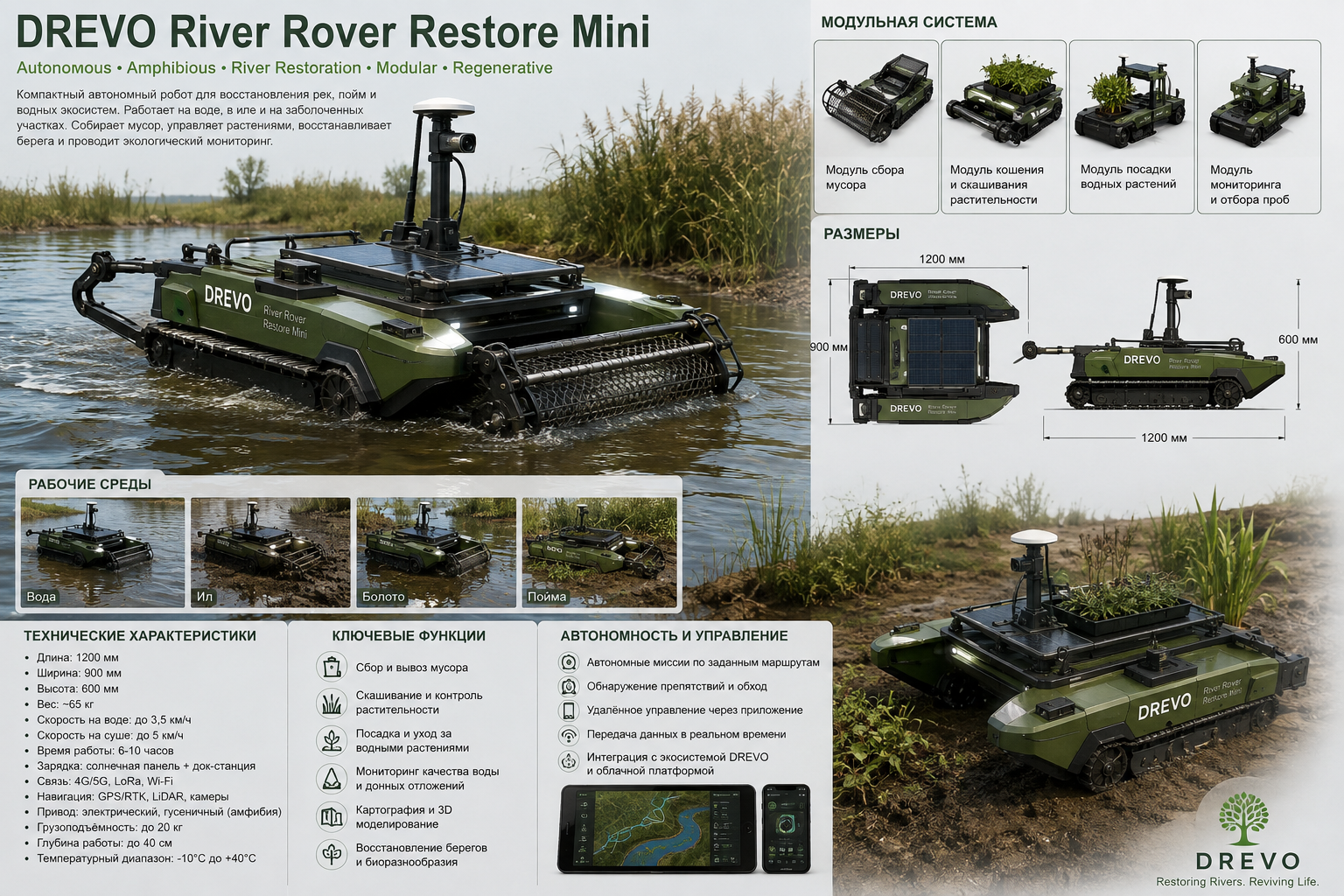
DREVO River Rover Restore— a robotic modular platform for restoring the natural structure of rivers, streams, floodplains and wetlands after survey stages (River Rover Scout) and cleaning (River Rover Clean).
The main task isdon't build an artificial river, but help the river restore its natural processes.
"Restore Nature — Don't Replace It." "Restore nature, don't replace it."
Main tasks
Restoration of the natural riverbed.
Restoration of springs.
Restoration of spawning grounds.
Restoration of floodplains.
Restoration of swamps.
Restoration of the banks.
Restoration of river vegetation.
Restoration of forest ecosystems along rivers.
Increasing the self-cleaning capacity of the river.
Increasing biodiversity.
River Rover Restore Family
| Model | Purpose |
|---|---|
| Restore Mini | Springs, mountain streams, small canals |
| Restore S | Small rivers |
| Restore M | Middle rivers |
| Restore L | Large rivers and floodplains |
| Restore XL | Deltas, reservoirs, large-scale restoration projects |
Main modules
River Morphology Module
Restores:
natural bends of the riverbed;
rifts;
braids;
gravel areas;
stone thresholds;
natural water pockets.
The goal is to increase the diversity of currents and habitats.
Spawning Habitat Module
Creation and restoration:
spawning grounds;
gravel areas;
shelters for fry;
zones of weak current.
Used:
natural gravel;
boulders;
wooden structures;
living root systems.
Spring Recovery Module
Works:
clearing spring outlets;
restoration of filtration zones;
soil stabilization;
planting moisture-loving plants.
Floodplain Restoration Module
Restores:
floodplain lakes;
oxbow lakes;
seasonal channels;
swampy areas.
This allows the river to overflow safely during floods.
Riverbank Stabilization Module
Natural methods are used:
live willow stakes;
fascines;
timber piles;
root mats;
stone riprap;
coconut biomats.
Woody Habitat Module
Placed:
large logs;
root stumps;
tree debris.
Purpose:
creation of shelters;
slowing down of the current;
accumulation of organic matter;
formation of new microchannels.
Aquatic Vegetation Module
Landing:
rug;
sedges;
reed;
arrowhead;
susak;
local underwater plants.
Living River Engineering
Basic principle:
Maximum of natural materials.
Used:
boulders;
gravel;
sand;
wood;
live plants;
natural soils.
The use of concrete and other rigid structures is minimized.
Working with wood
Part of the wood:
used to restore the riverbed;
forms shelters for fish;
retains sediment;
stabilizes the banks.
Some of the most valuable bog wood can be raised and transferred toDREVO Timber Reserve.
Working with stones
River Rover automatically:
sorts boulders;
forms thresholds;
creates rollovers;
restores the riverbed structure.
Working with the floodplain
The following are being restored:
seasonal flooding;
waterlogging;
meadow areas;
floodplain forests.
Landing:
alder;
willow;
elm;
ash tree;
poplar.
Biological restoration
Conditions are being created for the return:
fish;
crayfish;
bivalve mollusks;
amphibians;
dragonflies;
mayflies;
caddis flies;
waterfowl.
Unique technologies
Adaptive River Builder
Artificial intelligence analyzes:
flow speed;
depth;
soil type;
history of the riverbed.
After this, it offers optimal natural solutions.
Eco Placement System
The robot automatically places:
stones;
log;
plants;
fascines
in the most effective places.
Smart Habitat Generator
Created:
quiet backwaters;
deep holes;
areas of fast current;
spawning zones;
shelters for young fish.
Living Root Planting
Automatic landing:
willows;
alder;
shrubs;
aquatic plants.
Integration
| System | Purpose |
|---|---|
| River Rover Scout | Pre-work survey |
| River Rover Clean | Preparatory cleaning |
| River Cargo Platform | Delivery of stones, wood and plants |
| Living Mountain Observatory | Monitoring recovery results |
| Mountain Digital Twin | Change history and digital model |
| WOOD AI | Work planning and efficiency forecasting |
| TREVO AeroSense Drone | Monitoring the riverbed condition from the air |
Stages of work
River Rover Scout data analysis.
River Rover Clean.
Restoration of hydromorphology.
Planting plants.
Creation of habitats.
Monitoring.
Correction based on DREVO AI data.
Priority restoration sites
| Object | Priority |
|---|---|
| Springs | ⭐⭐⭐⭐⭐ |
| Spawning grounds | ⭐⭐⭐⭐⭐ |
| Floodplain forests | ⭐⭐⭐⭐⭐ |
| Swamps | ⭐⭐⭐⭐⭐ |
| Small streams | ⭐⭐⭐⭐ |
| Shores | ⭐⭐⭐⭐ |
| Old women | ⭐⭐⭐⭐ |
| Deltas | ⭐⭐⭐⭐ |
| Artificially straightened riverbeds | ⭐⭐⭐⭐ |
Expected results
restoration of the natural course;
increasing biodiversity;
improving water quality;
increase in fish numbers;
reduction of erosion;
increasing flood resilience;
restoration of floodplain forests;
growth of groundwater reserves;
strengthening the river's ability to self-purify.
Role in DREVO Living Mountains
DREVO River Rover Restorecompletes the watershed restoration cycle:
Scout → Clean → Restore → Observatory → Digital Twin → DREVO AI
In this way, a continuous system of river management is formed:
Scoutstudies and maps;
Cleanremoves dirt and dangerous obstacles;
Restorerestores natural processes;
Living Mountain Observatorycontrols the results;
Mountain Digital Twinstores the history of changes;
WOOD AIanalyzes data and plans further actions.
It is this cycle that allows us to move from one-time jobs tolong-term adaptive management of river ecosystems, where each subsequent decision is based on monitoring data and the state of nature.