DREVO River Rover Restore S
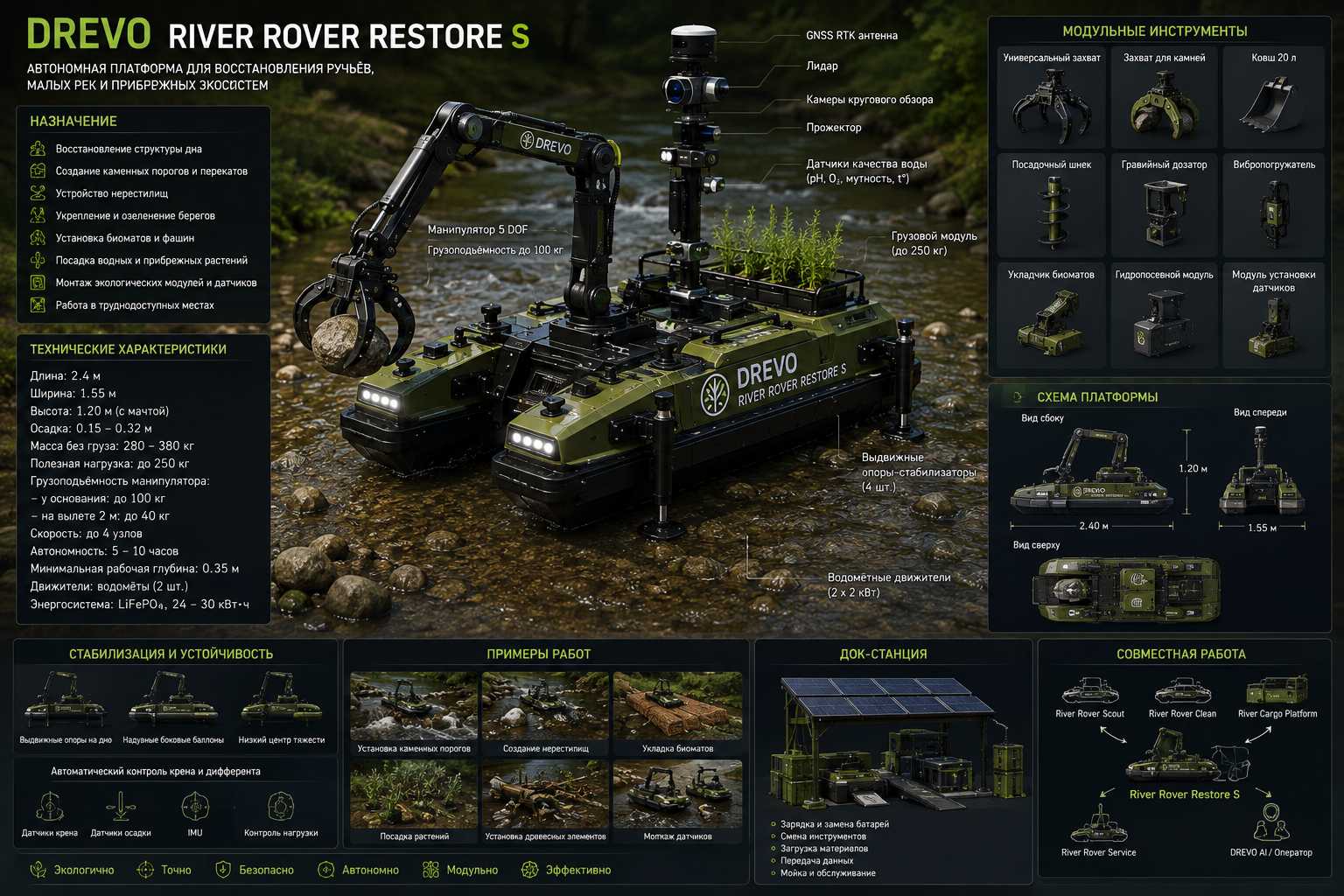
A compact, autonomous platform for restoring streams, small rivers, and riparian ecosystems
Concept
DREVO River Rover Restore S (RRR-S)— a lightweight, low-profile robotic platform for targeted restoration of small streams and shallow-water ecosystems.
It is designed for work where heavy equipment cannot be used without destroying the banks, soil and natural structure of the riverbed:
in mountain streams;
small rivers;
narrow channels;
swamps;
old women;
floodplain channels;
spring areas;
shallow lagoons.
The platform performs small but numerous operations: laying stones, installing biomats, planting plants, creating spawning areas, and deploying ecological modules.
The main principle:
Minimal platform weight, high operational precision and minimal impact on the ecosystem.
Main purpose
River Rover Restore S is used for:
restoration of stream bottoms;
installation of small stone thresholds;
creation of microcascades;
laying gravel and pebbles;
formation of small spawning grounds;
restoration of eroded banks;
installation of coconut rollers and biomats;
planting of aquatic and coastal plants;
placement of wooden elements;
installation of sensors;
maintenance of previously restored areas.
Main advantages
shallow draft;
compact dimensions;
low weight;
Possibility of transportation on a regular trailer;
work without excavators;
high positioning accuracy;
replaceable tools;
remote and autonomous control;
minimal increase in water turbidity;
the ability to work as part of a group of robots.
Basic design
The platform is designed according to the catamaran scheme.
Main elements:
two sealed pontoons;
central working frame;
small robotic manipulator;
replaceable tool module;
cargo area;
navigation mast;
cameras;
sonar;
depth sensors;
electric propulsion;
stabilizing supports.
The catamaran layout ensures stability when operating the manipulator and allows the working tool to be placed between the pontoons.
Preliminary dimensions
| Parameter | Design value |
|---|---|
| Length | 1.8–2.8 m |
| Width | 1.2–1.8 m |
| Body height | 0.45–0.70 m |
| Height with mast | 1.2–1.8 m |
| Draft without cargo | 0.12–0.20 m |
| Draft with working load | 0.20–0.35 m |
| Minimum working depth | about 0.30–0.40 m |
| Platform weight | 180–450 kg |
| Payload | 100–300 kg |
The values are preliminary and will be refined after the calculation of the hull and equipment.
Cargo area
The compact cargo platform is designed for transportation of:
stone;
gravel;
biomat;
plants;
wood elements;
sensors;
tools.
Approximate dimensions of the cargo area:
length: 0.8–1.5 m;
width: 0.7–1.2 m;
usable area: 0.6–1.5 m².
For heavy materials, low-lying containers are provided between the pontoons.
Manipulator
The platform is equipped with one compact electro-hydraulic or electromechanical manipulator.
Design characteristics
| Parameter | Meaning |
|---|---|
| Load capacity at base | 80–150 kg |
| Load capacity at maximum reach | 25–60 kg |
| Working flight | 1.5–2.5 m |
| Angle of rotation | 270–360° |
| Positioning accuracy | 2–5 cm |
| Manipulator weight | 40–100 kg |
When working with heavy objects, the platform lowers the stabilizing supports.
Replaceable tools
Universal grip
For:
stones;
log;
containers;
plant modules.
Stone Capture
For precise placement of pebbles and small boulders.
Small ladle
For:
local sludge removal;
formation of planting recesses;
preparation of spawning areas.
Planting tool
For:
sedge;
rushes;
aquatic plants;
shrub cuttings.
Biomat Capture
Used for laying:
coconut mats;
jute nets;
vegetable rolls.
Vibratory pile driver
To install:
wooden stakes;
anchors;
biomat fastenings.
Gravel dispenser
Distributes gravel evenly across the bottom.
Sensor Tool
For installation and replacement of environmental sensors.
Restoration of small thresholds
The River Rover Restore S creates sills with a height of approximately:
10–40 cm for small streams;
up to 60 cm with a separate engineering calculation.
Used:
local stone;
pebble;
wood;
bioengineered fastenings.
The threshold must:
reduce water speed;
do not interfere with the migration of organisms;
have a stable foundation;
have a protected area below the overflow;
do not direct the flow into the eroding bank.
Restoration of spawning grounds
The platform delivers and distributes:
washed gravel;
pebbles;
small boulders;
tree shelters.
The following are taken into account when designing:
water depth;
flow speed;
material size;
types of fish;
spawning season;
risk of flooding.
Work is not carried out during the period of active reproduction of sensitive species.
Working with the banks
The platform performs:
installation of coconut rollers;
laying biomats;
fascia installation;
planting live willow cuttings;
placement of root systems;
formation of gentle coastal edges;
installation of small wooden fortifications.
River Rover Restore S is not intended for the construction of massive retaining walls.
Landing module
The platform can land:
sedges;
sieves;
marsh irises;
cattail, where it is a native species;
aquatic plants;
willow cuttings;
coastal shrubs.
The landing module includes:
plant cassettes;
capture;
auger or punch;
water supply system;
landing control camera.
Work in the swamps
An amphibious version is available for swamps and soft soils.
Possible propellers:
wide rubber tracks;
low pressure screw propellers;
removable support skis;
water jet propulsion systems for swimming.
The specific pressure on the soil should be minimal so as not to destroy peat and marsh vegetation.
Stabilization
During work the following are used:
two or four retractable supports;
bottom pins;
temporary anchors;
inflatable side bladders;
automatic roll correction.
The manipulator is blocked if:
the permissible list has been exceeded;
the mass of the object is not determined;
the supports are not installed;
the current exceeds the safe value.
Navigation
The platform is equipped with:
GNSS RTK;
inertial module;
LiDAR;
front and all-round cameras;
ultrasonic sensors;
sonar;
current sensors;
position holding system.
In narrow forest streams, where the satellite signal is weak, the following are used:
visual navigation;
LiDAR map;
coastal radio beacons;
local labels.
Environmental monitoring
The platform can measure:
water temperature;
pH;
dissolved oxygen;
electrical conductivity;
turbidity;
depth;
flow speed;
condition of the bottom material.
If the permissible turbidity level is exceeded, the operation automatically slows down or stops.
Power system
Recommended configuration:
LiFePO₄ batteries;
replaceable battery cartridges;
two independent electric motors;
separate battery for the manipulator;
charging from a shore station.
Approximate parameters:
| Parameter | Meaning |
|---|---|
| Battery capacity | 10–40 kWh |
| Propeller power | 2 × 1–3 kW |
| Manipulator power | 2–8 kW |
| Autonomy in monitoring | 8–14 hours |
| Autonomy during active work | 4–8 hours |
| Speed | up to 3–5 knots |
Transportation
River Rover Restore S is transported:
on a car trailer;
in a small truck;
на River Cargo Platform;
by helicopter or cargo drone for particularly hard-to-reach areas - only in a lightweight version.
Launch possible:
from the shore;
from a small pier;
along the guides;
crane;
via River Hub.
Collaboration
Typical scheme:
River Rover Scoutexamines the stream.
WOOD AIidentifies problem areas.
River Rover Cleanremoves debris.
River Cargo Sdelivers materials.
River Rover Restore Sinstalls thresholds, gravel and plants.
River Rover Serviceplaces sensors.
Living Mountain Observatory monitors the recovery.
Modifications
Restore S Stream
For mountain streams.
Peculiarities:
enhanced body protection;
short manipulator;
work among stones;
small width.
Restore S Wetland
For swamps and floodplains.
Peculiarities:
amphibious chassis;
low ground pressure;
landing module;
working with biomats.
Restore S Habitat
To restore habitats.
Peculiarities:
gravel dispenser;
wood laying;
installation of underwater modules.
Restore S Plant
Specialized landing version.
Peculiarities:
increased supply of cassettes;
automatic landing;
hydroseeding;
introduction of biological preparations.
Restore S Sensor
For installation of sensors and scientific equipment.
Preliminary specification
| Parameter | River Rover Restore S |
|---|---|
| Length | 1.8–2.8 m |
| Width | 1.2–1.8 m |
| Weight | 180–450 kg |
| Payload | 100–300 kg |
| Draft | 0.12–0.35 m |
| Load capacity of the manipulator | up to 80–150 kg at the base |
| Working flight | 1.5–2.5 m |
| Speed | up to 3–5 knots |
| Autonomy | 4–14 hours |
| Working depth | from 0.3 m |
| Drivers | 2 electric |
| Management | autonomous and remote |
| Navigation | GNSS RTK, LiDAR, cameras, sonar, IMU |
| Working tools | replaceable |
| Electronics protection | IP67/IP68 |
Restrictions
River Rover Restore S is not suitable for:
lifting boulders weighing more than 100–150 kg without external support;
large-scale deepening of the riverbed;
work in strong currents;
construction of permanent dams;
removal of large volumes of bottom sediments;
high wave work;
replacement of full-fledged earthmoving equipment in large projects.
Its strength is a multitude of small, precise operations.
Expected effect
Using the platform allows you to:
restore small watercourses without heavy equipment;
reduce the cost of local work;
reduce coastal damage;
restore spawning grounds;
increase the diversity of the channel;
accelerate plant survival;
work in hard-to-reach places;
keep a digital history of each transaction.
Mission
DREVO River Rover Restore S— is a compact, ecological structure for small water systems. It doesn't transform a stream into an artificial channel, but instead selectively restores rocks, gravel, wood, vegetation, and natural shelters.
Together with other platforms of the DREVO family, it provides a complete cycle:
inspection → cleaning → delivery → restoration → monitoring → maintenance.
It is the thousands of small restoration projects on streams, springs and small rivers that shape the health of the entire large river system.