DREVO River Rover Restore Mini
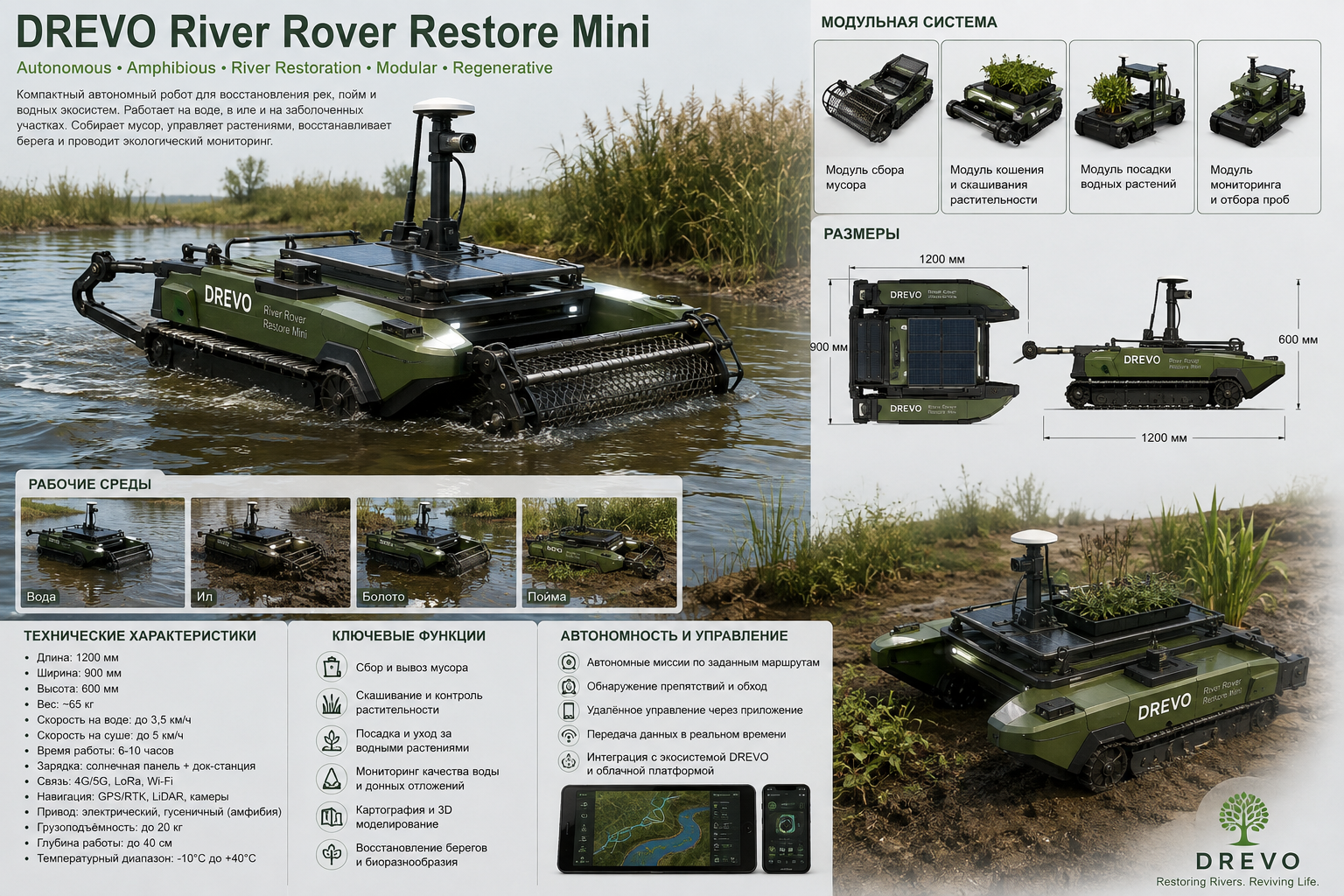
An ultra-light robotic platform based on the principle of a kayak or canoe
Concept
DREVO River Rover Restore Mini (RRM-Mini)— the most compact platform of the familyRiver Rover, designed to restore springs, forest streams, narrow rivers and swampy areas where it is impossible to deliver heavy equipment.
The platform is similar in designa wide, stable kayak (or canoe)With a central operating module. The narrow hull ensures minimal current resistance, shallow draft, and the ability to operate even in very shallow waters.
The main principle:
One person can move the platform to a remote stream, after which it independently carries out restoration work.
Main tasks
The platform is designed for:
restoration of springs;
formation of small stone thresholds;
laying of individual boulders;
gravel distribution;
planting of coastal plants;
installation of sensors;
installation of biomats;
fastening of wooden elements;
surveys of hard-to-reach areas;
maintenance of previously restored facilities.
Main dimensions
| Parameter | Meaning |
|---|---|
| Length | 2.8–3.6 m |
| Width | 0.75–0.95 m |
| Body height | 0.30–0.45 m |
| Draft | 8–15 cm |
| Platform weight | 40–90 kg |
| Payload | 80–150 kg |
| Working depth | from 15–20 cm |
Housing construction
The basis is a type caseSit-on-Top Kayak.
Materials:
rotational polyethylene (HDPE);
fiberglass;
carbon fiber (light version);
aluminum power frame.
Inside the hull there are sealed buoyancy compartments.
Propulsion system
Three versions are available:
River Jet
Two compact electric water jets.
River Prop
Two protected propellers in ring nozzles.
River Fin
Oscillating fin propulsors for areas with dense vegetation and minimal impact on the bottom.
Energy system
Used:
LiFePO₄ batteries;
replaceable battery cartridges;
solar panel for powering electronics.
Parameters:
| Parameter | Meaning |
|---|---|
| Battery capacity | 2–8 kWh |
| Autonomy | 4–8 hours |
| Speed | up to 5 km/h |
Working module
A compact robotic arm is installed in the center of the body.
Features:
| Parameter | Meaning |
|---|---|
| Departure | 0.8–1.2 m |
| Load capacity | 15–30 kg |
| Turn | 360° |
| Degrees of freedom | 4–5 |
This is sufficient for precise nature restoration work.
Replaceable tools
Supported:
stone grab;
landing auger;
gravel spreader;
biomat installation tool;
planting module;
sensor grip;
small ladle;
seed and mycorrhiza dispenser.
Cargo compartment
Replaceable containers are located in the bow and stern.
Possible options:
stone;
gravel;
plants;
tools;
battery;
scientific equipment.
Stabilization system
To ensure precise work the following is provided:
retractable side outriggers;
small inflatable cylinders along the body;
automatic position holding;
electronic roll control.
During movement, the stabilizers fold into the body.
Navigation
The complex includes:
GNSS RTK;
NOSE;
stereo cameras;
Small radius LiDAR;
population;
ultrasonic sensors.
In dense forests the following are used:
visual navigation (Visual SLAM);
local radio beacons;
digital map of the stream.
Environmental monitoring
The following are measured simultaneously:
water temperature;
pH;
dissolved oxygen;
turbidity;
electrical conductivity;
depth;
flow speed.
Transportation
The main advantage of the platform.
It can be transported:
by one person;
in the back of a pickup truck;
on the roof of the car;
on a small trailer;
by helicopter;
cargo drone;
on foot to hard-to-reach areas.
Collaboration
River Rover Restore Mini can be used with:
River Rover Scout- reconnaissance;
River Rover Restore S- more difficult operations;
River Cargo Platform— delivery of materials;
TREVO AeroSense Drone- aerial survey;
Living Mountain Observatory— monitoring;
Mountain Digital Twin— digital model;
WOOD AI— planning routes and tasks.
Main advantages
ultra-shallow draft;
work at a depth of less than 20 cm;
transportation by one person;
low cost;
minimal impact on nature;
possibility of mass application;
high accuracy of restoration;
modular design;
work in the most inaccessible places.
Promising modifications
Restore Mini Plant- automatic planting.
Restore Mini Spring— restoration of springs.
Restore Mini Habitat— creation of spawning grounds and shelters for aquatic organisms.
Restore Mini Sensor— installation and maintenance of a sensor network.
Restore Mini Survey— mapping and environmental monitoring.
Project mission
DREVO River Rover Restore MiniDesigned to restore the upper reaches of watersheds—springs, forest streams, and small rivers—the platform combines high mobility, minimal environmental impact, and the ability to perform precise restoration work where traditional equipment is impossible or unfeasible.