DREVO River Cargo Platform
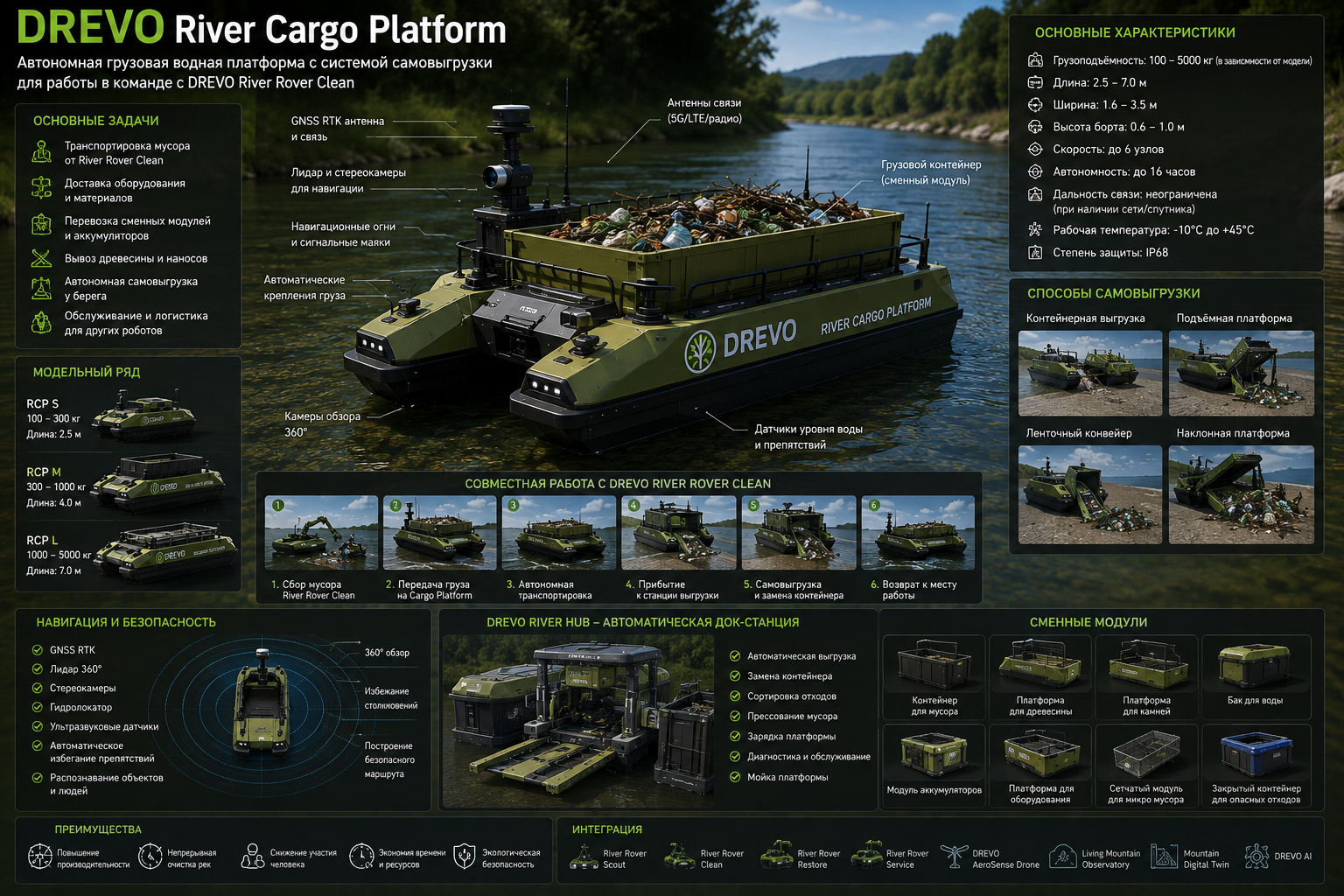
Autonomous semi-truck water platforms with a self-unloading system for collaboration with DREVO River Rover Clean
Concept
DREVO River Cargo Platform (RCP)— a family of autonomous aquatic semi-cargo platforms designed for transporting waste, timber, equipment, building materials, and replacement modules. The platforms operate in conjunction with robots.DREVO River Rover Clean, forming a single robotic system for cleaning and maintaining rivers.
Instead of wasting time transporting waste to the shore, River Rover Clean simply collects waste and loads it onto a platform. Once full, the platform automatically travels to the nearest unloading station, empties, and returns to its work site.
The main principle:
A working robot cleans the river, a transport robot carries cargo.
Project mission
Create a fully autonomous logistics system that would allow rivers to be cleaned 24/7 without human intervention.
Main tasks
The platform is designed for:
transportation of collected waste;
container delivery;
transportation of building materials;
equipment delivery;
transportation of replacement batteries;
timber removal;
supplies for other robots.
Main platform options
DREVO River Cargo S
Compact platform.
Load capacity:
100–300 kg.
Used by:
on small rivers;
mountain streams;
streams.
DREVO River Cargo M
Middle platform.
Load capacity:
300–1000 kg.
The most versatile version.
DREVO River Cargo L
Heavy-duty cargo platform.
Load capacity:
1–5 tons.
Used by:
on large rivers;
lakes;
reservoirs.
Construction
Basic diagram:
catamaran.
Advantages:
high stability;
shallow draft;
large usable area;
the ability to transport heavy containers.
Cargo deck
The platform is equipped with:
container fasteners;
roller guides;
automatic locks;
lifting frame.
Self-unloading
The main feature of the platform.
Various modes are used.
Container unloading
The container automatically:
unlocks;
moves to the shore;
is replaced by an empty one.
Belt conveyor
Used for:
garbage;
wood;
stones;
sand.
Lifting platform
Raises the cargo platform.
Allows you to download:
containers;
large-sized items;
building materials.
Inclined platform
On the principle of a dump truck.
Used by:
for organics;
wood chips;
sediments;
stones.
Robotic overload
At the station, the robot automatically:
removes the filled container;
sets empty;
performs diagnostics;
charges the platform.
The entire process takes a few minutes and does not require the presence of an operator.
Collaborating with River Rover Clean
Work scenario:
River Rover Clean collects waste.
Transfers it to the Cargo Platform.
Cargo Platform automatically tracks fill levels.
Once filled, it goes to the shore station on its own.
Performs automatic unloading.
Returns to River Rover Clean.
If necessary, several platforms can be serviced by one cleaning robot.
Working in a swarm
Several platforms operate simultaneously.
Artificial intelligence distributes:
routes;
unloading order;
loading;
energy consumption.
This allows for the almost continuous cleaning of large river systems.
Navigation
Used:
GNSS RTK;
lidar;
stereo cameras;
sonar;
inertial system;
Automatic obstacle avoidance.
Energy supply
Used:
replaceable batteries;
solar panels for powering auxiliary systems;
automatic charging stations;
Inductive charging at the pier (optional).
DREVO River Hub docking stations
Automatic stations are located along the river banks.
They perform:
charging;
replacement of containers;
waste sorting;
waste compaction;
washing of platforms;
technical maintenance;
battery exchange.
Additional modules
Waste Container
Garbage container.
Wood Transport
For wood.
Stone Transport
For boulders and gravel.
Sediment Box
For contaminated bottom sediments.
Battery Module
For transporting spare batteries to other robots.
Water Tank
Transportation of water.
Used by:
for extinguishing fires;
watering;
restoration of ecosystems.
Plant Module
Shipping:
trees;
shrubs;
marsh plants.
Used in conjunction with River Rover Restore.
Intelligent control
WOOD AI
Manages:
all logistics;
delivery order;
route optimization;
loading platforms;
filling forecast.
Integration
The platform works in conjunction with:
DREVO River Rover Scout;
DREVO River Rover Clean;
DREVO River Rover Restore;
DREVO River Rover Service;
Living Mountain Observatory;
Mountain Digital Twin;
TREVO AeroSense Drone;
WOOD AI.
Development prospects
In the future, the system can be expanded by:
automatic floating sorting stations;
mobile press compactors;
floating plastic recycling stations;
hazardous waste containers;
microplastic collection modules;
autonomous floating power plants.
Economic benefits
The use of transport platforms allows:
increase the performance of River Rover Clean several times;
eliminate robot downtime during transportation;
reduce the number of service personnel;
automate waste removal;
reduce operating costs;
ensure round-the-clock operation of the entire system.
Project mission
DREVO River Cargo Platformis the logistical link of the systemDREVO Living MountainsTogether with robotsRiver Rover Scout, River Rover Clean, River Rover Restore And River Rover ServiceIt forms a fully autonomous river maintenance network, where exploration, cleaning, transportation, restoration, and monitoring are performed by a distributed group of specialized robots. This approach ensures continuous cleaning of water bodies, minimizes human intervention, and significantly increases the efficiency of river ecosystem restoration.