Functions of greenhouses
DREVO's semi-buried greenhouses serve not as a standalone facility, but as a production hub: they provide a flow of seedlings, root shrubs, germinate herbs, and harden plants before planting them in the corridor.
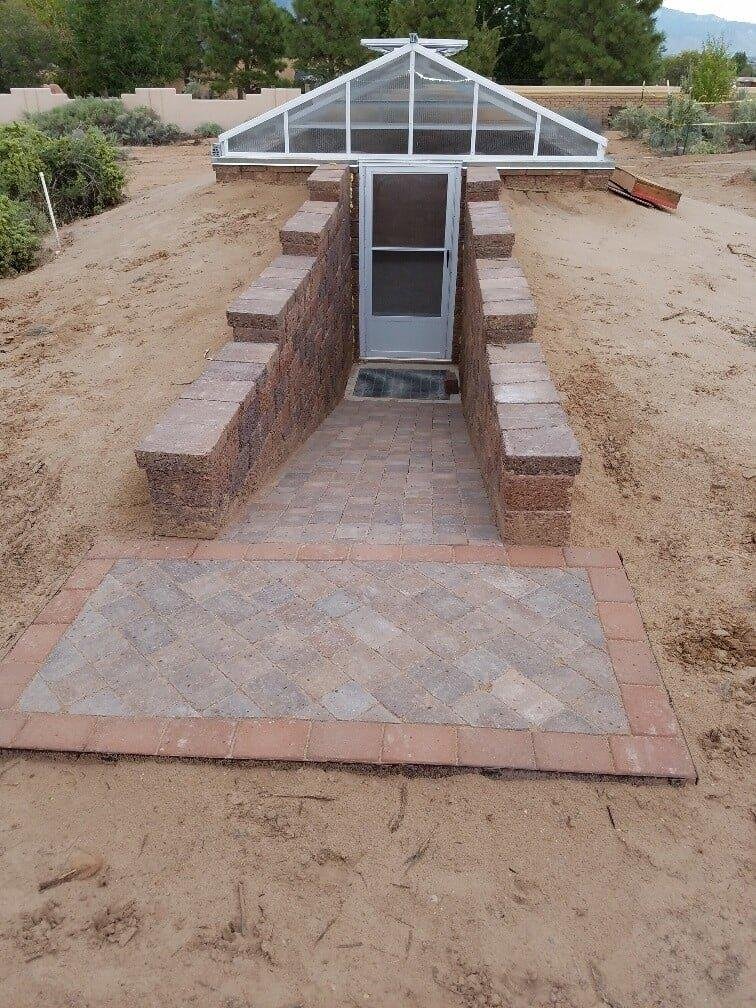
Nursery logic
The greenhouse creates a flow of planting material
The main goal of the greenhouses is not to cover the entire kilometer with structures, but to create propagation hubs. Their capacity determines how quickly the project can plant herbs, shrubs, and trees without relying entirely on external nurseries.
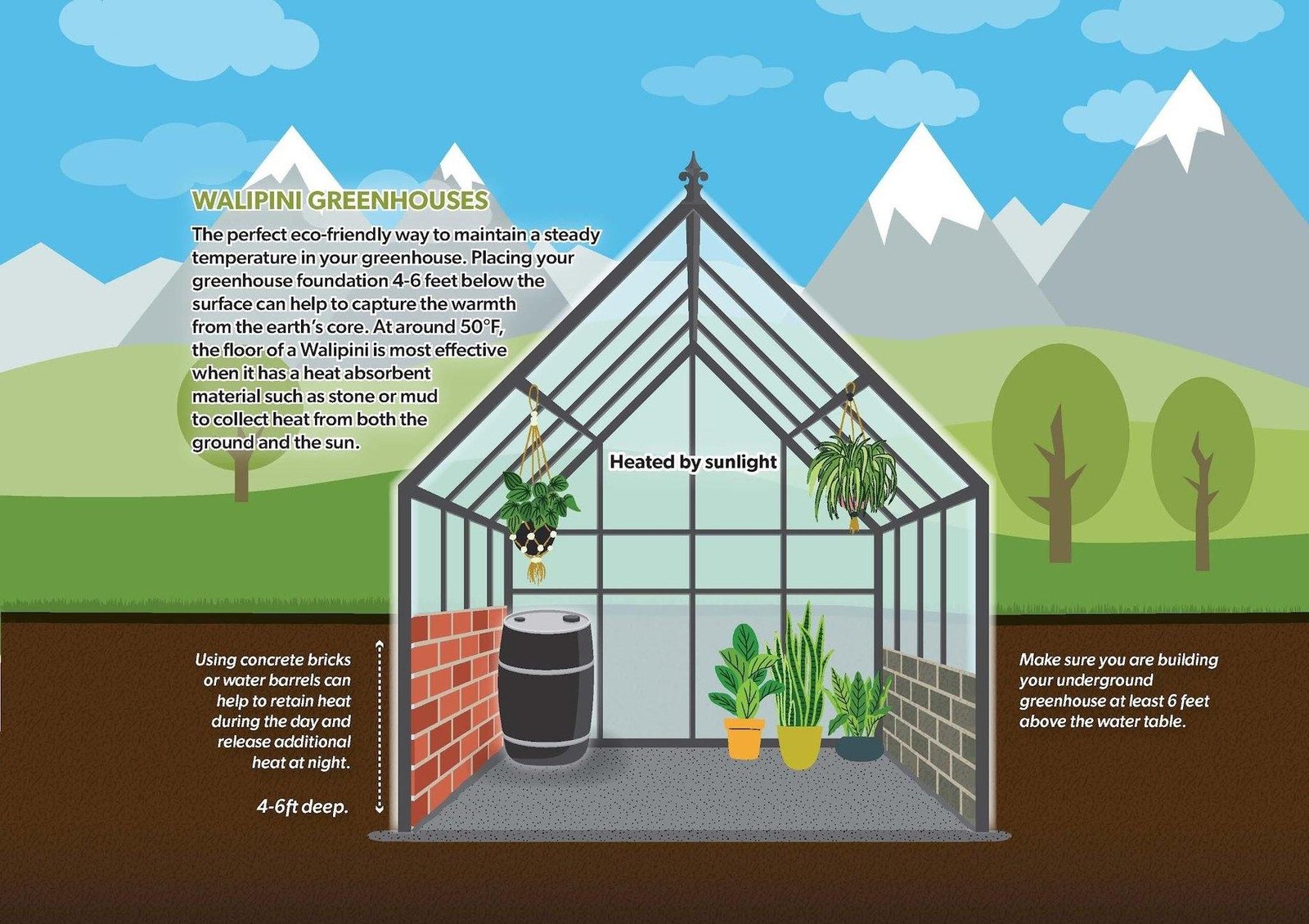
The soil acts as a thermal buffer, and the containers and stones help retain the heat.
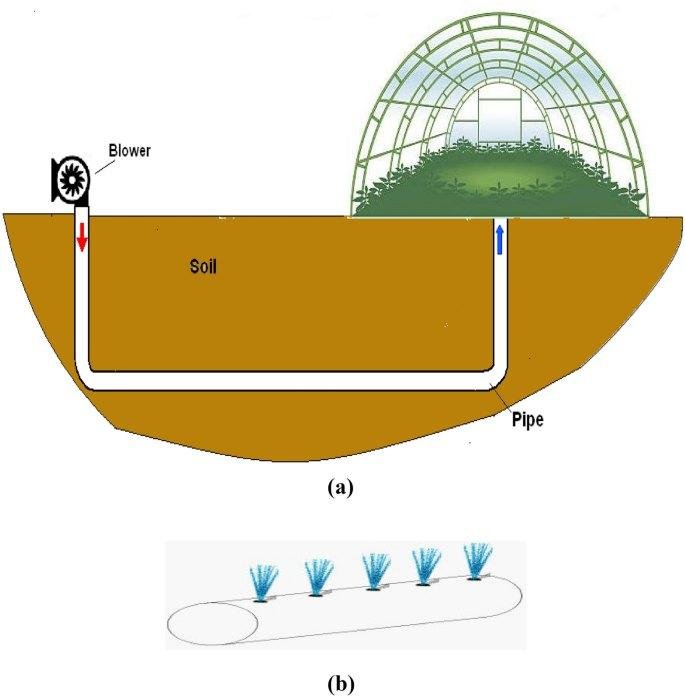
The diagram shows how ventilation and ground heat exchange stabilize the microclimate.
Main functions
| Function | What to grow | Why is this necessary? |
|---|---|---|
| Propagation of seedlings | trees and protective species | create a stock of planting material |
| Rooting shrubs | Atriplex, tamarisk, native resistant shrubs | quickly close protective strips |
| Sprouting herbs | soil-forming and forage grasses | launch a live top layer |
| Hardening | seedlings before planting | reduce losses after transfer to the field |
| Reserve | replacement of dead plants | maintain the project after the initial stresses |
Realistic module
An average semi-buried pilot greenhouse is 3 meters wide, 8 meters long, and has an area of approximately 24 square meters. When properly configured, such a module can simultaneously support approximately 300-600 tree seedlings in cassettes or 800-1,500 grasses and groundcover plants.
| Format | Size | Production role |
|---|---|---|
| Main greenhouse | 3 x 8 m | tree seedlings, shrubs, mixed cycle |
| Small hardening greenhouse | 2 x 4 m | adaptation before landing and temporary reserve |
| Nursery hub | a cluster of several greenhouses | constant flow of plants for 1-5 km |
How many greenhouses are needed per 1 km?
| Scale | Greenhouses per 1 km | What does this give? |
|---|---|---|
| Minimal pilot | 2-3 | 600-1800 tree seedlings per cycle, some plants are purchased |
| Working standard | 4-6 | 1200-3600 woody seedlings per cycle plus grasses and shrubs |
| Intensive system | 8-12 | almost autonomous nursery, but higher demand for water and staff |
For the pilot kilometer, it is optimal to lay out 6 greenhouses: 4 main semi-buried greenhouses 3 x 8 m and 2 small greenhouses for hardening.
Accommodation along the corridor
do not distribute greenhouses evenly every 150-200 m
form nursery clusters in more stable areas
Place 2 greenhouses in zone 4 and 2-4 greenhouses in zone 5
Use zone 3 only in good microclimate
Avoid placing greenhouses too close to the ocean, where the salt and wind are higher
Scaling
| Project length | Minimum | Optimum |
|---|---|---|
| 1 km | 4 greenhouses | 6 greenhouses |
| 3 km | 12 greenhouses | 15-18 greenhouses |
| 5 km | 20 greenhouses | 25-30 greenhouses |
When expanding, it is better to build not a continuous chain, but a system of nodes: a central nursery node, intermediate nodes and local hardening greenhouses near the planting zones.